What the RPC Is and Who Must Notify
The register exists so that Tox Info Suisse can answer an emergency call about a product at 3 a.m., and so that cantonal enforcement can check what is on the shelf. The rules come from the Chemicals Ordinance (ChemV), Articles 48 to 54:
- Operated by the Notification Authority for Chemicals (Anmeldestelle Chemikalien) at the FOPH, on behalf of the FOPH, FOEN, FOAG and SECO. A public part can be queried by anyone; the protected part is where notifiers maintain their products.
- The duty falls on whoever places the product on the Swiss market. An importer, including a parallel importer, counts legally as the manufacturer and carries all of the manufacturer's obligations.
- Hazardous substances and preparations must be notified: anything classified for physical, health or environmental hazards.
- So must non-hazardous preparations that contain a health- or environment-hazardous substance at 1 % or more, which is also the trigger for a safety data sheet.
- Any product carrying a UFI (unique formula identifier) on its label or safety data sheet must be notified, even if it would otherwise be exempt.
- The deadline is three months after first placing on the market in Switzerland, import included.
- Products for exclusively professional or industrial use only need notifying above 100 kg per year.
- Biocidal products and parallel-imported plant protection products go through the same register under their own guidance.
- Cosmetics and foodstuffs are not in scope; they are regulated under food law. Notification itself is free of charge.
The result? For a typical cleaning or DIY range, most of the assortment is notifiable, and every reformulation, relabel or new pack size can trigger an update.
The obligation is well understood by the people who hold the RPC login. The problem is that they are rarely the people who hold the product data.
→ See how xyxle manages hazardous substance data todayWhat a Notification Contains
A notification is entered in the RPC application and has to match the label and the safety data sheet exactly. The core content is:
- Product identity: trade name, UFI, intended use (private, professional, industrial), physical state, packaging types and sizes.
- Composition: every relevant component with CAS or EC number and its concentration or concentration range.
- Classification and labelling: GHS hazard classes, hazard and precautionary statements, pictograms and signal word, consistent with the label and the safety data sheet.
- Physicochemical data such as pH, and the safety data sheet itself where one is required.
- Quantity category placed on the market, the responsible company and its contact, and an update whenever the name, composition or classification changes.
RPC vs. EU Poison Centre Notification
Since 2018 the Swiss notification has been aligned in parts with Annex VIII of the EU CLP Regulation, the basis for poison centre notification (PCN) via ECHA. Aligned is not identical:
- Both are built around the UFI and a similar core data set, so a company that has done PCN has most of the content already.
- The RPC differs in detail: quantity categories, the private versus professional split, pH, and what is expected from the safety data sheet.
- An EU notification does not count in Switzerland. The Swiss importer must notify to the RPC separately, in the Swiss application, not the ECHA portal.
- Labels and data must respect Swiss language rules, which means German, French and Italian rather than one EU language.
- The RPC feeds Tox Info Suisse for emergency calls and Swiss market surveillance; PCN feeds the EU poison centres. Two audiences, two registers, one product.
For a Swiss importer of EU-made products this is the daily reality: the formulation and PCN dossier exist at the parent company; the Swiss notification is a translation job that lands on the local team.
→ See the full list of xyxle featuresWhat Changes for Brands and Importers
None of this is new law. What is changing is the volume: UFI on every consumer product, new CLP hazard classes phasing in through 2028, and retailers asking for hazard data as structured attributes. The work looks like this:
- Know your scope: which of your products are classified, which carry a UFI, and which cross the 1 % threshold even without a hazard label.
- Hold composition and classification as structured data per product, not only inside the safety data sheet PDF.
- Track the three-month clock from the first Swiss shipment of every new product and every changed formulation.
- Keep the label, the safety data sheet and the notification saying the same thing, in three languages, after every change.
- If you are the Swiss subsidiary or importer of an EU brand, the duty is yours even though the formulation is not. Get the data flowing from the parent company in a form you can use.
Every one of those five is a data-management task. The register is simply the last place the data has to arrive.
What Changes for Retailers
Retailers often assume the RPC is the supplier's problem. For own brands and imports it is not, and for everything else it is a due-diligence question:
- Own brands: as the company placing the product on the market, you carry the notification duty yourself, formulation from a contract manufacturer or not.
- Direct and parallel imports: importing makes you the manufacturer in the legal sense, with the same three-month deadline.
- Supplier onboarding: check that UFI, hazard classification, safety data sheet and notification status are part of the data you collect for chemical ranges.
- Online and shelf-edge: hazard pictograms and statements have to appear on product pages, which only works if they exist as data.
- Inspections: cantonal chemicals enforcement checks retail shelves against the register. Missing notifications land on the retailer first.
The retailer that collects UFI, classification and notification status at listing has an answer ready for the inspector. The one that does not is searching through supplier emails.
Where Companies Get Stuck
Companies rarely fail the RPC because they do not know the rules. They fail it because the data is in the wrong shape and the wrong hands:
- Composition and classification exist only in the safety data sheet, so every notification means retyping from a PDF
- The RPC login sits with one person, the product data with another, and the three-month clock with nobody
- A reformulation reaches the label and the retailer months before it reaches the register
- Parent-company data arrives in the EU PCN format and is manually translated, product by product, into Swiss fields and languages
Why this matters:
- The register exists for emergency calls: a wrong or missing entry is a safety failure, not a paperwork one
- Late or missing notifications are found in routine cantonal inspections
- New CLP hazard classes are being phased in through 2028, so classifications will change for many products
- Every hour spent retyping is an hour not spent checking that the data is right
Hold the data once, in a structured record with an owner, and the notification stops being a separate task.
Coming soon
The xyxle RPC Translator
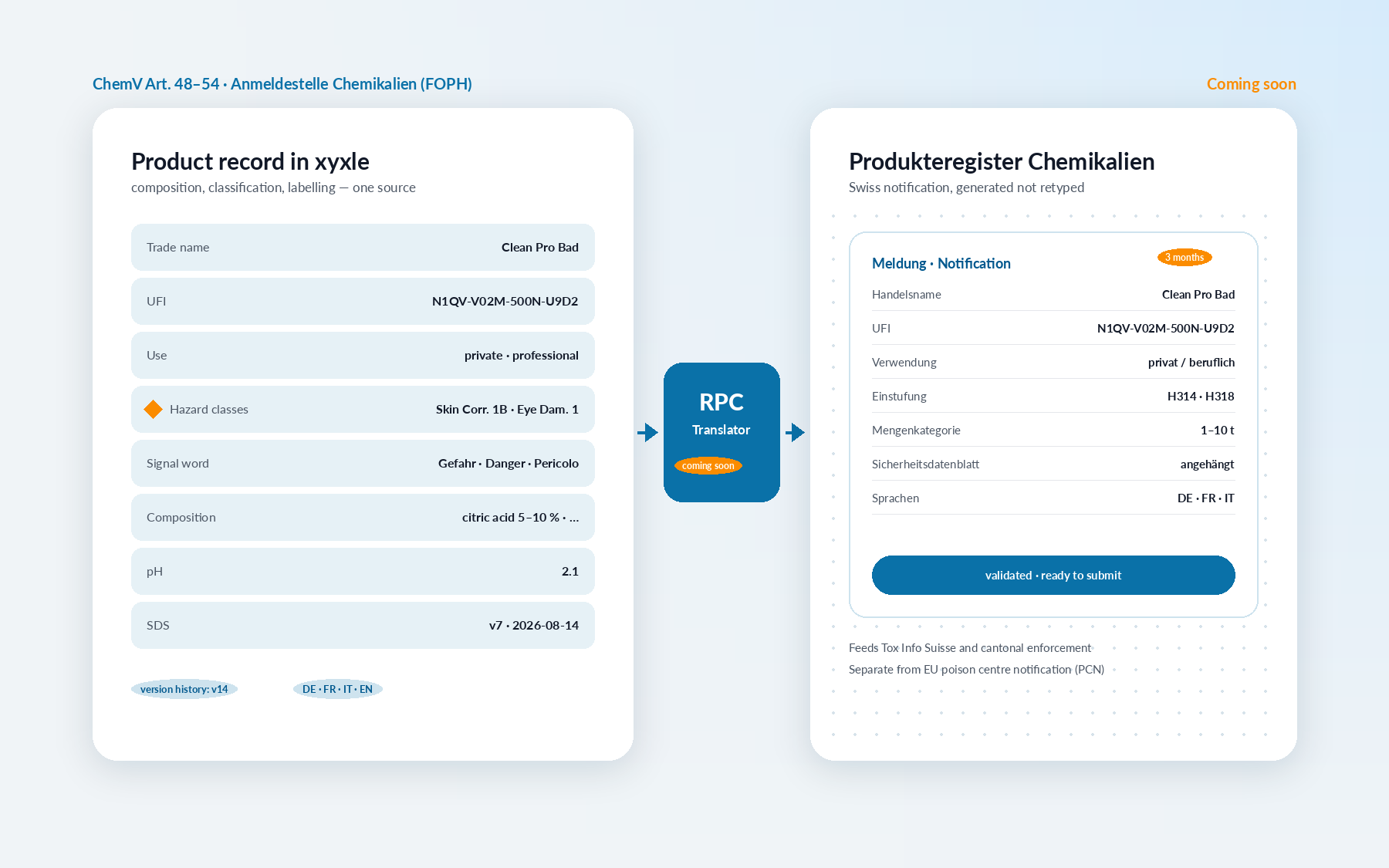
We are building an RPC Translator inside xyxle: a channel that takes the composition, classification and labelling data you maintain in the product record and turns it into a Swiss register notification. It is in development, and we are looking for launch partners with real chemical ranges to shape it. Here is what it is designed to do:
- One source: composition, hazard classification, UFI, use category, packaging and the safety data sheet live in the xyxle product record, next to the GS1 data your retailers already receive.
- Translation to the register: the RPC Translator maps those fields to the structure the Swiss register expects, in German, French and Italian, so a notification is generated rather than typed.
- Validation first: completeness and consistency checks between label, safety data sheet and notification before anything is submitted.
- Deadline tracking: the three-month clock per product, from first Swiss shipment, with the notification status visible on the item.
- Change propagation: when a formulation, classification or name changes in the record, the register update is flagged, with the full version history behind it, as it already is for hazardous substance data today.
The same record feeds your retailers through GDSN, your consumers through article passports and 2D barcodes, and the authority through the register. One truth, several outputs.
If you notify more than a handful of products a year, or you are the Swiss importer for an EU brand, we would like to talk to you before we finish it.
A Practical RPC Roadmap
You do not have to wait for the Translator to start. Steps one to four make every notification faster today and are the prerequisite for automating it:
- Scope: list every chemical product you place on the Swiss market, its hazard classification, UFI and current notification status.
- Structure: bring composition, classification and safety data sheet data into xyxle as fields and attachments, per product.
- Reconcile: compare what the register says today with what your record says, and fix the differences once.
- Govern: route formulation and classification changes through approval, so the register update is triggered by the same event as the label change.
- Translate: when the RPC Translator launches, generate notifications and updates from the record instead of re-entering them.
Steps two and three are where most of the effort sits, and they pay off immediately in fewer inconsistencies between label, safety data sheet and register.
Launch partners get to influence which fields, validations and workflows the Translator supports first.
→ Inquire now about early access to the RPC TranslatorOne Record for the Label, the Retailer and the Register
The RPC is one more consumer of the same product truth that your labels, safety data sheets, retailers and consumers depend on. Companies that keep that truth in one governed place notify in minutes and update without fear. Companies that keep it in PDFs and inboxes do the same work three times and still get it wrong.
xyxle already holds hazardous substance data with full version history, in German, French, Italian and English. The RPC Translator is the missing last mile, and it is on its way.
Whether you notify ten products or a thousand, the register should be an output of your data, not a second copy of it.
.png)