This page is for brand owners, packaging and regulatory teams, and retailers in food, beverage, cosmetics and consumer goods who want to understand what is changing, what GS1 actually requires, and how to get ready without rebuilding their whole product data operation.
Keep reading to learn what a 2D barcode is, how GS1 defined the standard, what GS1 Digital Link makes possible, and how xyxle turns your existing product data into the foundation for 2D codes on every pack.
A linear (1D) barcode encodes data in one direction only: the widths of its bars. That limits it to a single number, the GTIN. A 2D barcode encodes data in two directions, in a grid of squares, so the same footprint on the pack can carry far more. GS1 has standardised two 2D symbols for retail: the GS1 DataMatrix, already mandatory on EU prescription medicines, and the QR code carrying a GS1 Digital Link URI. Both are read by camera-based imager scanners rather than lasers. Alongside the GTIN, a GS1 2D barcode can encode:
The result? One code on the pack does what a barcode, a QR code, a lot number and a website address used to do separately. At the till it still returns the GTIN, so checkout works exactly as before. Everywhere else, from the warehouse to the consumer's phone, it unlocks data the old barcode never had.
For companies managing hundreds or thousands of products, this changes the question from "which code do we print?" to "is our product data complete, correct and structured enough to encode?" A 2D barcode is only as good as the data behind it.
→ See how xyxle structures product data for GS1GS1 is the not-for-profit body that has governed product identification since the first barcode was scanned in 1974. Its General Specifications define GTINs, the Application Identifiers (AIs) that describe batch, expiry, weight and more, and which barcode symbols may be used where. After years of pilots with retailers, brands and scanner manufacturers, GS1 and its member community agreed on a global migration milestone and named it, in the tradition of Sunrise 2005 (the move to 13-digit GTINs), Sunrise 2027. Here is what it actually says:
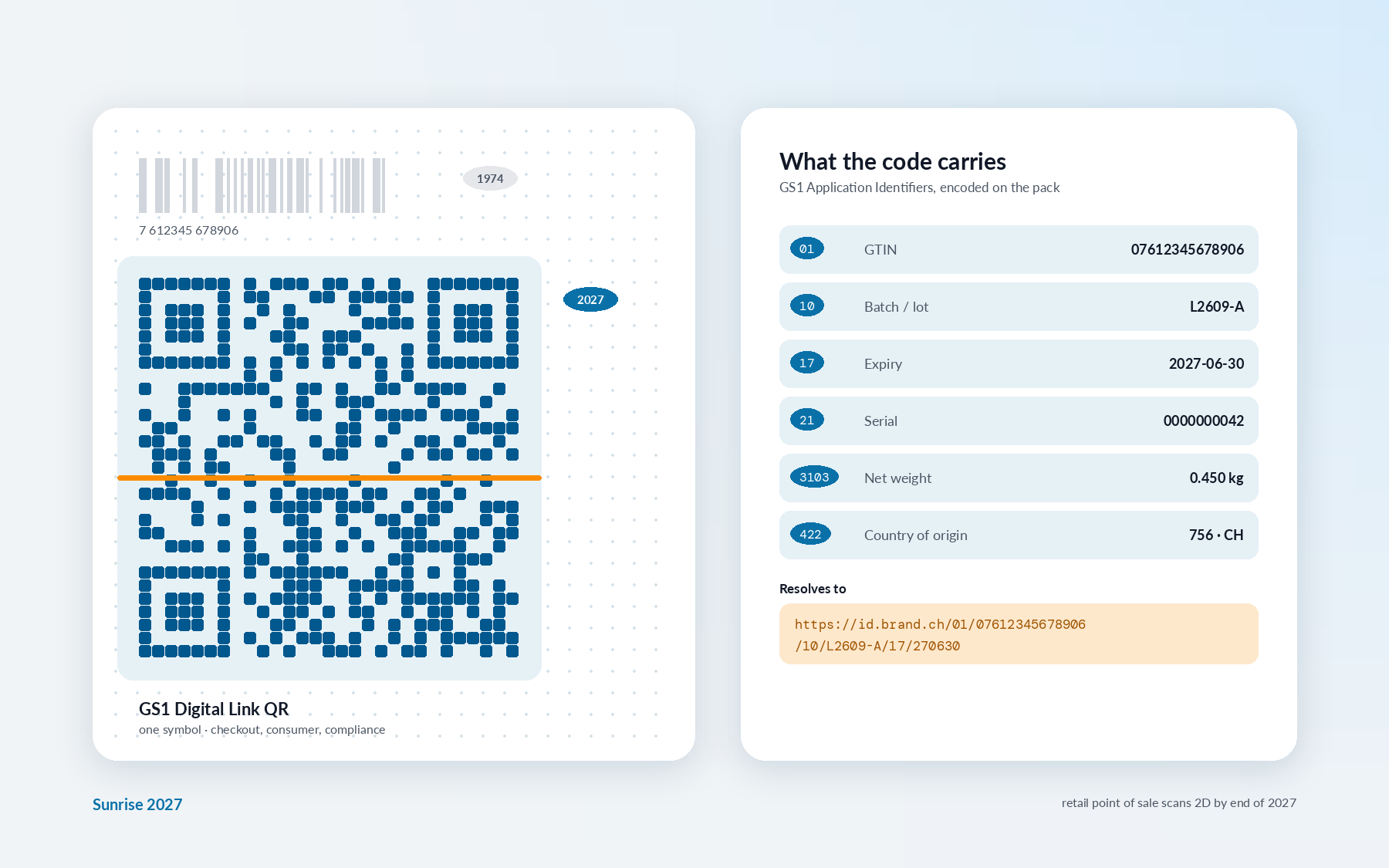
GS1 Digital Link is the standard that lets a QR code work at the till and on a phone at the same time. Instead of a bare number, the code contains a web address structured with GS1 identifiers, for example https://id.yourbrand.com/01/09506000134352/10/ABC123/17/261231. The 01 is the AI for GTIN, 10 is the batch, 17 is the expiry date. A point-of-sale scanner extracts the GTIN and ignores the rest. A smartphone opens the link, and a GS1 resolver routes it to the right content for that product, market and context.
The resolver is the clever part: you never hard-code a URL onto the pack. But it also means the content behind every link has to exist, be correct and stay current for the life of the product. That is a product data problem, not a printing problem.
→ See the full list of xyxle featuresNobody is forcing you to reprint every pack in 2027. But the brands that move early get the upside: fewer recalls, richer consumer engagement, and readiness for regulations that increasingly demand batch-level data on the product. For most brand owners the work breaks down into five streams:
Four of those five streams are about data, not artwork. Which is why the companies that already run their product information through a GS1-based PIM find 2D adoption to be an incremental step rather than a project.
Retailers sit at the centre of Sunrise 2027, because the whole initiative hinges on the checkout being able to read the new code. Grocery is affected most, with perishables, frequent recalls and thousands of suppliers. The hardware upgrade is the visible part; the data work behind it is where the value is:
For a retailer, the biggest risk is not that a 2D code fails to scan. It is that the data it reveals from a supplier contradicts what is already in the retailer's own systems. Clean supplier onboarding into a single golden record is the prerequisite.
Generating a GS1 DataMatrix or Digital Link QR code takes seconds with free GS1 tools. The difficulty is that every field you encode or link to must exist, be correct, be formatted to GS1 rules and stay in sync across ERP, packaging, data pools and retailer portals. In the companies we work with, the typical gaps look like this:
Why this matters specifically for 2D barcodes:
Get the data right once, in one place, and the code becomes a formality.
xyxle is a PIM and data-exchange platform built on the GS1 GDSN data model, used by Swiss and European brands and retailers to manage more than 80,000 GTINs. That makes it the natural system of record for everything a 2D barcode encodes or links to:
You do not need a separate "2D project". If the product data is right in xyxle, the 2D code is a matter of choosing the symbol and printing it.
And because xyxle already speaks GDSN, GPC and the retailer formats you use today, nothing about your existing syndication changes. 2D readiness is an extension of the same golden record, not a parallel system.
Sixteen months sounds like a long time until you count the packaging print runs, artwork approvals and retailer test cycles between now and December 2027. Here is the sequence we recommend, and where xyxle fits at each step:
Whether you are a brand preparing your first dual-marked range or a retailer onboarding hundreds of suppliers, the first three steps are the same, and they are the ones xyxle takes off your plate.
Most customers complete steps one to three within a few weeks of onboarding, because the GS1 structure is already built into the platform.
→ Talk to us about a 2D readiness assessmentThe last barcode transition, Sunrise 2005, took the industry the better part of a decade to fully absorb. This one carries more data, touches more systems and arrives at the same time as the EU Digital Product Passport and tighter traceability rules. The companies that treat it as a data-quality initiative rather than a printing change will be the ones whose products scan, resolve and comply on day one.
xyxle gives you a GS1-native golden record, live multilingual product pages for your Digital Links, and the export channels to get the right data onto the pack, all from the same platform you use for GDSN and retailer syndication today.
Whether you manage 50 GTINs or 50,000, the path to 2D-ready packaging starts with data you can trust.
.png)