What the PPWR Is and Who It Applies To
The PPWR is a regulation, not a directive. It applies directly and identically in every Member State, with no national transposition and no grace period. It covers all packaging placed on the EU market and assigns obligations to every economic operator in the chain:
- Sales (primary), grouped (secondary), transport (tertiary) and e-commerce packaging are all in scope, regardless of material.
- Manufacturers must run a conformity assessment, issue a declaration of conformity and keep technical documentation for each packaging type.
- If you market packaged goods under your own brand, you carry the manufacturer obligations for that packaging.
- Importers must verify conformity before placing goods on the EU market and keep the declaration available for authorities.
- Distributors and retailers must check that the declaration and the required labels exist before they sell.
- Fulfilment service providers and online marketplaces have their own due-diligence duties for e-commerce packaging.
- Producers must register for extended producer responsibility in every Member State where they place packaging on the market.
- Swiss and other non-EU companies are affected through their EU importer or authorised representative, and through the data their EU retailers now demand.
- Misleading environmental labels, marks and symbols on packaging are prohibited from day one.
The result? Packaging compliance is no longer something a packaging supplier handles on your behalf. The brand that places the product on the market owns the declaration, the documentation and the data, and has to be able to show it.
For a company with a few hundred SKUs and several packaging components each, that is thousands of data points to collect, verify and keep current, per market.
→ See how xyxle models packaging hierarchies and attributesThe PPWR Timeline: What Applies When
Most companies know one date, 12 August 2026. The obligations that will actually change packaging design land later, and they need supplier data and lead time now:
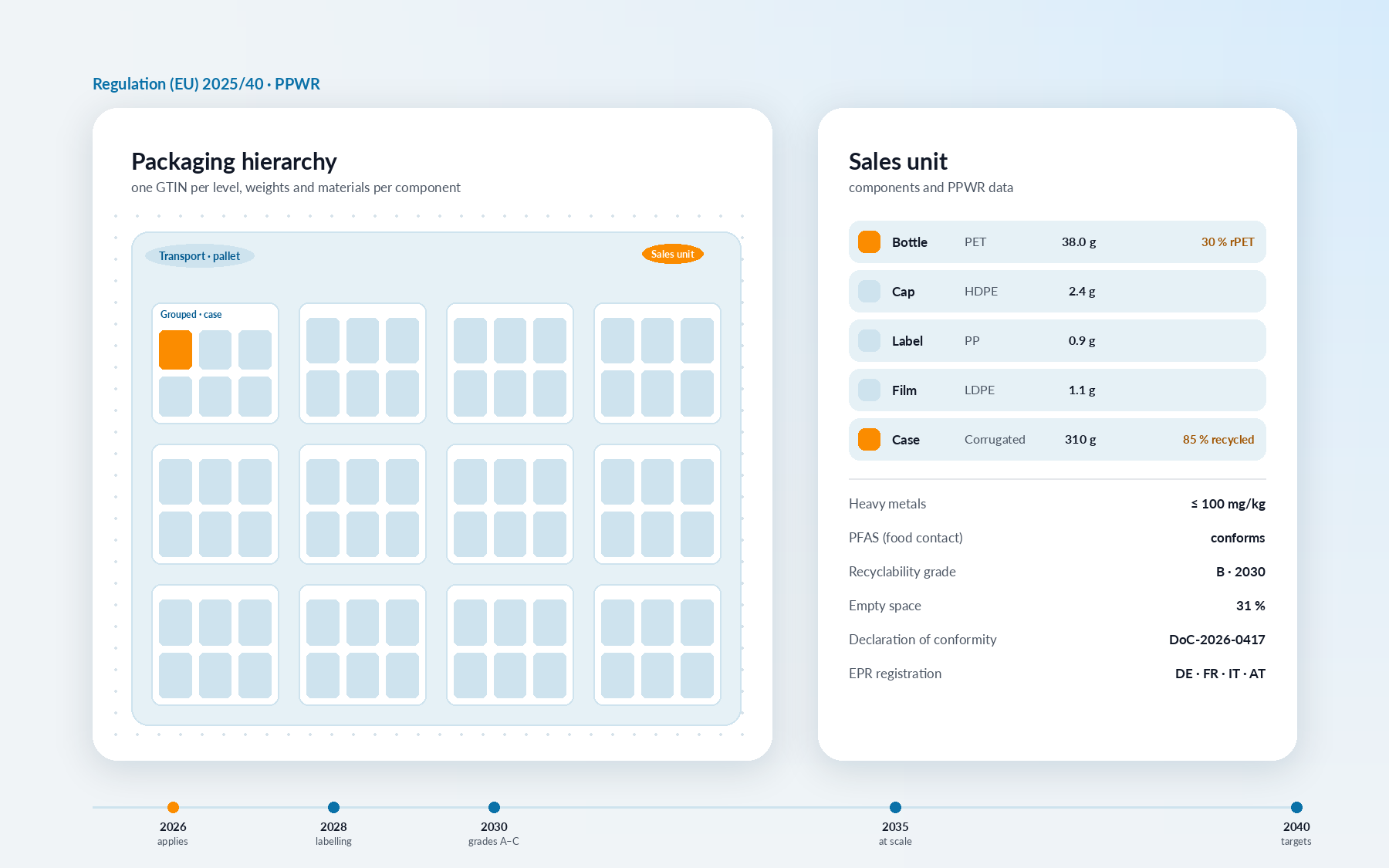
- 12 August 2026: the regulation applies. Declaration of conformity and technical documentation per packaging type, heavy-metal limits (lead, cadmium, mercury and hexavalent chromium together below 100 mg/kg), PFAS limits in food-contact packaging, EPR registration, and the ban on misleading labels.
- 12 August 2028: harmonised labelling. Material composition pictograms and sorting information on every pack, with a data carrier such as a QR code for the digital part.
- 1 January 2030: recyclability performance grades A, B or C become mandatory, minimum recycled content applies to plastic packaging, grouped, transport and e-commerce packaging may contain at most 50% empty space, and the first reuse targets and format bans take effect.
- 1 January 2035: packaging must be recyclable at scale, meaning actually collected, sorted and recycled in practice across the EU.
- 2038 and 2040: only grades A and B remain permitted, and recycled-content targets rise again.
Why the PPWR Is a Product Data Problem
Read the regulation through a data lens and every article resolves to fields that must exist per packaging component and per SKU. Multiply by the components in one pack and by the levels of the logistics hierarchy, and you have the real scope:
- Packaging composition per component: material, sub-material, weight, colour and additives for the bottle, the cap, the label, the tray, the film, the case and the pallet.
- The recyclability grade and the assessment evidence behind it, once the grading acts apply.
- Recycled-content share per plastic component, backed by supplier certificates.
- Substance statements from packaging suppliers confirming heavy-metal and PFAS compliance.
- Operator identification, declaration-of-conformity references and EPR registration numbers, per market.
Retailers are already asking for most of this through GDSN packaging attributes and supplier portals. The PPWR makes it a legal requirement rather than a commercial one, and the 2028 digital labelling connects it to the same GS1 Digital Link QR code that Sunrise 2027 puts on your pack.
→ Read our guide to 2D barcodes and GS1 Sunrise 2027What Changes for Brand Owners and Manufacturers
For a brand, the PPWR turns packaging from a procurement topic into a governed data domain. The work breaks down into five streams, and four of them are about data rather than materials:
- Collect packaging specifications from every packaging supplier, per component, and keep them current when a supplier changes a material or a grade.
- Produce and store a declaration of conformity and the technical documentation for each packaging type, and be able to hand it to an authority or a retailer within days.
- Prepare artwork for the 2028 harmonised labels and decide on a data carrier; a GS1 Digital Link QR code can carry the digital labelling and the checkout scan on one symbol.
- Report packaging placed on the market to the national EPR registers, Member State by Member State, from the same weight and material data.
- Redesign towards grade A or B and the recycled-content minimums before 2030. The data tells you which SKUs are at risk and how much packaging you actually place per market.
Companies that already manage their product data in a GS1-based PIM find that the PPWR mostly adds attributes to records they have, rather than a new system.
What Changes for Retailers and Distributors
Retailers sit at the end of the chain and carry due-diligence obligations for everything they sell, plus full manufacturer obligations for own brands. That makes supplier packaging data a core part of listing:
- Due diligence: confirm that every product you list carries a declaration of conformity and compliant labelling, and be able to prove you checked.
- Own-brand ranges: you carry the full manufacturer obligations for that packaging, including the technical documentation.
- Supplier onboarding: collect packaging data from hundreds of suppliers in a structured, comparable form instead of PDFs by email.
- EPR reporting: declare packaging volumes for own-brand and imported goods per market, from weights you can trace back to the item.
- Commercial use: EPR fees are modulated by recyclability, so packaging data becomes a cost lever, not just a compliance record.
The retailer's biggest risk is not a non-compliant pack. It is not being able to show, for thousands of suppliers, that the data was collected and checked.
Where Companies Get Stuck
The regulation is demanding, but the failure mode we see is rarely about materials. It is about where the data lives:
- Packaging specifications arrive from suppliers as PDFs and are filed in email, not in a system
- The ERP has a single "packaging material" field for a pack that has six components
- No link between the packaging data and the GTIN hierarchy, so the case and the pallet are never counted
- Declarations of conformity exist somewhere, but nobody can produce the right one for the right packaging type on request
Why this matters now:
- Without a declaration of conformity, packaging cannot legally be placed on the EU market since 12 August 2026
- Retailers can and will delist products whose packaging data they cannot verify
- EPR fees are calculated from weights and materials you report, so wrong data costs real money
- Every 2030 redesign decision needs a data baseline you do not have yet
Get packaging data into the same governed record as the rest of your product information, and every later obligation becomes a report instead of a project.
How xyxle Helps You Implement the PPWR
xyxle is a PIM and data exchange platform built on the GS1 GDSN data model, which already describes packaging at every level of the hierarchy. That gives you a structured home for PPWR data without inventing a schema:
- Logistical hierarchies: model selling unit, inner pack, case and pallet with weights, dimensions and a GTIN per level, matching the PPWR's sales, grouped and transport packaging structure exactly.
- GDSN packaging attributes out of the box: packaging material, weight, recycled content, recyclability and labelling fields as defined by GS1, so what you record is what retailers already request through the data pool.
- Flex fields for the PPWR specifics: recyclability grade, empty-space ratio, PFAS and heavy-metal statements, EPR registration numbers per market, declaration-of-conformity reference and validity.
- Digital asset management for the evidence: attach supplier declarations, test reports and the declaration of conformity to the item itself, with version history.
- Supplier intake workflow: collect packaging data through the xyxle network, Excel templates or API, validate completeness, and approve it into the golden record.
Then share it from the same record: to retailers via GDSN and custom export channels, to partners and auditors via article passports, and to consumers via a GS1 Digital Link QR code.
One record, one set of weights and materials, feeding the declaration, the label, the EPR report and the retailer, so the numbers never disagree with each other.
A Practical PPWR Roadmap
Whether you are catching up on the 2026 obligations or planning for 2030, the sequence is the same, and xyxle supports each step:
- Inventory: list every packaging component per SKU and per hierarchy level, and who supplies it.
- Collect: request composition, weights, recycled content and substance statements per component, and load them into xyxle against the GTIN.
- Document: create the declaration of conformity and technical documentation per packaging type and attach them to the items they cover.
- Label: plan the 2028 harmonised labels and a data carrier, and generate the label content from the record rather than retyping it into artwork.
- Optimise: use the data to find the SKUs at risk for the 2030 grades, recycled-content minimums and empty-space cap, and prioritise redesigns.
Steps one to three are where most companies need help, and they are the ones xyxle's supplier intake, hierarchies and asset management take off your plate.
Steps four and five then run off the same data, with no second collection round.
→ Talk to us about a PPWR data readiness checkStart With the Data, Not the Artwork
The PPWR runs for fifteen years, and every stage asks for more of the same information: what your packaging is made of, how much of it there is, and whether you can prove it. The companies that treat it as a data-quality initiative now will spend 2028 and 2030 running reports, not rebuilding spreadsheets.
xyxle gives you the GS1 packaging model, supplier intake, evidence management and the channels to share it, in the platform you already use for GDSN and retailer syndication.
Whether you manage 50 packaging components or 50,000, compliance starts with knowing what is in the box.
.png)